Introduction
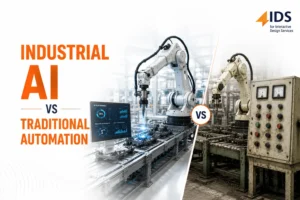
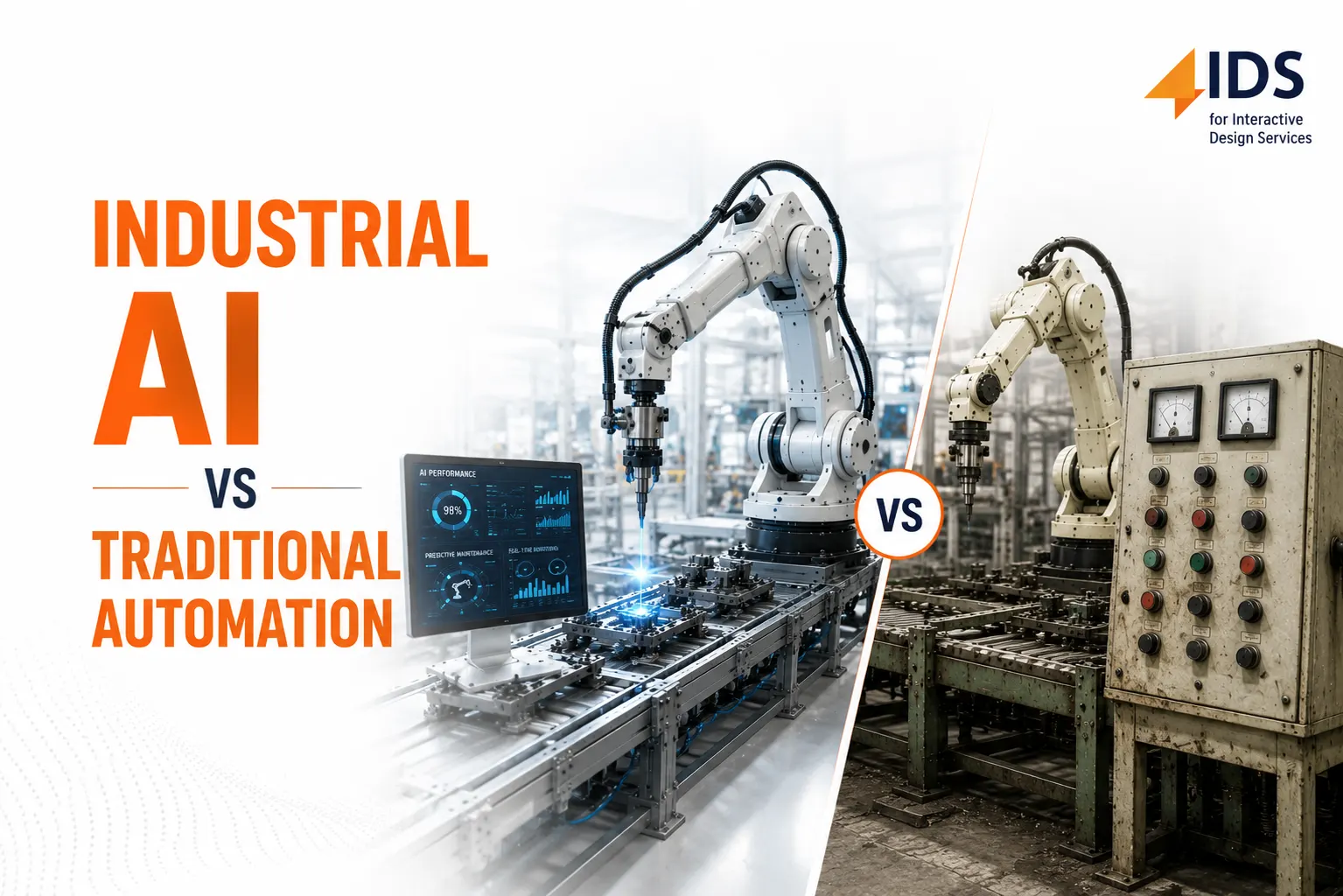
Industrial AI vs Traditional Automation helps manufacturers understand which technology fits their production needs. While traditional automation follows fixed rules, Industrial AI learns from data and improves over time. Additionally, AI can predict equipment failures before they happen. As a result, manufacturers reduce downtime and improve product quality. However, traditional automation is still valuable for repetitive and stable production tasks. Therefore, many businesses combine both technologies to achieve the best performance.
Why Industrial AI vs Traditional Automation Matters
Manufacturers today need greater flexibility, higher productivity, and better decision-making than traditional systems alone can provide.
Key advantages include:
- Improved production efficiency
- Better product quality
- Faster operational decisions
- Reduced downtime
- Lower maintenance costs
- Increased production flexibility
- Enhanced worker safety
- Higher return on investment
Choosing the right automation strategy directly impacts business growth and competitiveness.
Industrial AI vs Traditional Automation: Key Differences
Industrial AI
Industrial AI uses machine learning, computer vision, predictive analytics, and real-time data processing to improve manufacturing operations.
Capabilities include:
- Self-learning algorithms
- Predictive maintenance
- Intelligent quality inspection
- Production optimization
- Real-time analytics
- Adaptive decision-making
- AI-powered robotics
- Continuous improvement
Traditional Automation
Traditional automation relies on predefined programming and fixed operational logic.
Common features include:
- PLC programming
- Rule-based control
- Fixed workflows
- Scheduled operations
- Manual programming
- Standard process automation
- Repeatable production tasks
- Limited adaptability
Benefits of Industrial AI
Industrial AI offers advanced capabilities that extend beyond traditional automation.
Benefits include:
- Predictive maintenance
- Intelligent defect detection
- Dynamic production scheduling
- Real-time process optimization
- Automated data analysis
- Energy optimization
- Smart resource allocation
- Continuous system learning
These capabilities enable factories to respond quickly to changing production demands.
When Traditional Automation Is the Right Choice
Traditional automation remains an excellent solution for stable and repetitive manufacturing processes.
Ideal applications include:
- Conveyor systems
- Packaging lines
- Fixed assembly operations
- Material handling
- Standard machine control
- Batch processing
- Mechanical automation
- Simple production workflows
These environments often require reliable, predictable performance with minimal variation.
Combining AI with Traditional Automation
Many manufacturers achieve the best results by combining AI technologies with existing automation systems.
Integration options include:
- PLC Controllers
- SCADA Systems
- Industrial IoT Platforms
- MES Software
- ERP Systems
- Machine Vision AI
- Digital Twin Platforms
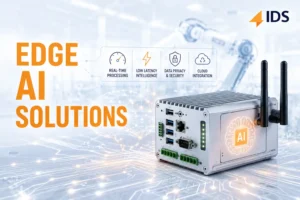
- Edge AI Solutions
This hybrid approach enhances existing investments while adding intelligent capabilities.
Industries Using Industrial AI
Modern AI-driven automation is transforming industries such as:
- Automotive
- Electronics
- Pharmaceuticals
- Food Processing
- Oil & Gas
- Chemical Manufacturing
- Renewable Energy
- Logistics
- Packaging
- Textile Manufacturing
Organizations benefit from higher productivity, better quality, and smarter decision-making.
Why Choose 4IDS?
At 4IDS, we help manufacturers modernize operations through intelligent automation and digital transformation.
Our expertise includes:
- Industrial AI Solutions
- Machine Vision AI
- Predictive Maintenance AI
- Edge AI Solutions
- Industrial IoT Platforms
- SCADA Development
- PLC Programming
- Digital Twin Development
- Website Development
- SEO Services
We design scalable, secure, and future-ready industrial solutions that improve efficiency and support Industry 4.0 initiatives.
Frequently Asked Questions
What is the difference between Industrial AI and Traditional Automation?
Industrial AI learns from operational data and adapts over time, while traditional automation follows fixed rules and predefined programming.
Can AI replace traditional automation?
Not entirely. Many businesses achieve the best results by combining AI with traditional automation technologies.
Is Industrial AI expensive?
The investment depends on project size, but AI often reduces long-term operational costs through predictive maintenance and optimized production.
Which industries benefit most from Industrial AI?
Manufacturing, automotive, pharmaceuticals, logistics, electronics, energy, and food processing industries all benefit from AI-powered automation.
Conclusion
Industrial AI vs Traditional Automation is not about choosing one over the other—it is about selecting the right approach for your operational goals. Traditional automation delivers dependable control for repetitive tasks, while Industrial AI adds intelligence, adaptability, and predictive capabilities. Together, they create smarter, more efficient manufacturing environments.
At 4IDS, we help businesses integrate AI with existing automation systems to build intelligent factories that are ready for the future.